by Docs Industries | Aug 12, 2015
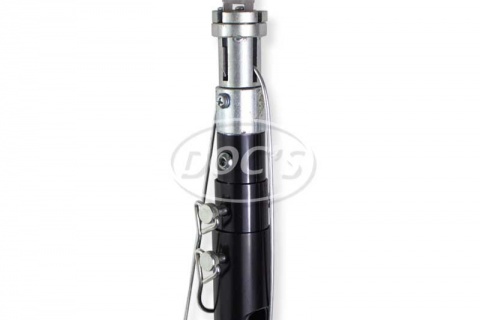 Inspiration for this tool came from watching a friend pre-wrap thousands of wires onto purlin clips, day after day in his shop. I thought to myself, there has got to be a faster and easier way to attach ceiling wire onto joists without the hassle of having to pre-wrap the wire.
Our solution is the PurlinMaster, a multi-purpose pole tool that allows you to install a purlin clip and then wrap ceiling wire to the clip using the same tool, all from the safety of the ground. This effectively eliminates the need for costly scaffolding and scissor lifts. No longer will you have to purchase and haul around messy pre-wrapped ceiling wire. Instead, hang and wrap on an as-needed basis.
The PurlinMaster is actually part of a proprietary system from Doc’s Industries Inc., which offers its own line of purlin clips designed to work with the PurlinMaster as well as traditional installation tools.
Past installation systems required the ceiling wire to be wrapped onto the clip before installation. The PurlinMaster system represents a major innovation in the installation of ceiling wire to purlin joists. It makes installing purlin clips as easy as installing ceiling wire with an eye lag screw. An added benefit to this tool is that the clip will not “pop off” as the clip is safely protected inside the head during installation.
The concept behind the PurlinMaster is a unique twist on the traditional eye lag pole, a tool that has been utilized by acoustical ceiling contractors for decades. In fact, the PurlinMaster even comes with an interchangeable head that converts the tool into a standard eye lag pole in seconds. This allows you switch from installing purlin clips to installing wood screws at a moment’s notice. There are several other interchangeable heads available for hanging threaded rod and jack chain, in addition to many other applications (sold separately).
The PurlinMaster requires the use of Doc’s™ proprietary purlin clips. Take a moment to watch the video found in the link below and you will see how easy it is to hang ceiling wire from z purlin or bar joists using this tool. http://www.purlinmaster.com
The PurlinMaster works with Doc’s™ ADOC14 “Z” purlin clip as well as Doc’s™ VOH14 “C” purlin clip. These clips install easily and are compatible with traditional installation tools like the Caddy® VAFT, Ramset® J-Master & Doc’s™ HOIT-AL tools.
Installation is completed in a handful of easy steps. Start by inserting a clip into the head of the PurlinMaster. Then thread the ceiling wire through the clip. Stand in front of the purlin joist and position the clip above the joist. Pull down on the pole, locking the teeth of the clip onto the joist. Then walk forward, pushing up to release the clip. Lower the pole down a couple inches, trapping the wire inside the ring. Now simply twist the wire onto the clip, just as you would twist wire on to an eye lag screw. No need to pre-wrap the wire onto the clip!
by Docs Industries | Jan 21, 2015
Doc’s® LS-6-3660 style extension pole was designed for use with both Hilti’s DX 36 and Ramset’s D-60.
The D-45 is essentially the same tool as the D-60, only with a shorter pin capacity.
by Docs Industries | Jan 30, 2014
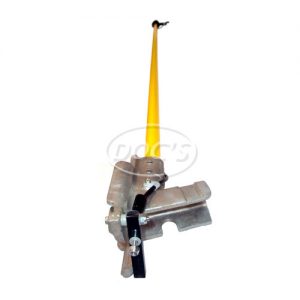 In the United States, most suspended ceilings are fastened to poured concrete decks using a powder actuated tool attached to an extension pole. An extension pole allows the installer to stay on the floor and avoid dangerous ladders or expensive scissor lifts. They also cut down on time and improve efficiency.
There are several manufacturers of powder actuated tools used in the suspended ceiling industry: Hilti, Ramset, Powers, Simpson and Bluepoint. The Hilti DX 350 powder actuated tool (PAT) and its cousin the DX35 has been the standard of the industry for many years. Most of the other manufacturers began making similar tools (knock offs) when Hilti’s patent expired. The extension poles offered by these manufacturers can be more expensive than the powder actuated tool itself. Luckily there are other companies making extension poles. The Long Shooter brand of pole tools for instance has a proven track record of high quality and is available at a low cost.
Typically an extension pole consists of a fiberglass pole with a means to secure the PAT tool on one end and a trigger pull on the other. The installer has to be protected from shock in case an electrical conduit is pierced by the PAT nail. Therefore, PAT extension poles are usually made of fiberglass and have a dielectric coupling to withstand up to 10,000 volts.
Ceiling wires pre-wrapped to an angle clip and a concrete pin are available at some of the larger distributors. Pre-wrapped ceiling wire assemblies coupled with an extension pole allow a single worker to install 700 or more ceiling wires in an average day. Most contractors customize their pole tool by attaching a short section of electrical conduit or PVC pipe to the side of the pole. This is used to hold a number of ceiling wire assemblies to cut down on trips back and forth to re-stock.
Ramset’s Viper tool was developed specifically for the suspended ceiling industry in the US. Early versions of Ramset’s Viper tool did not require a trigger-pull mechanism. Instead, the tool was pressed against the ceiling and the impact or “BUMP” activated the tool. This “BUMP” feature allowed the tool to be place on a simple and inexpensive telescoping pole. The latest version of the Viper, the Viper4, requires a trigger pull mechanism and a special extension tool. The Viper 4 is not a “BUMP” tool.
Powers Fasteners makes a “BUMP” tool similar to the older versions of the Viper. Powers calls their tool the Sniper. Most fans of the “BUMP” tool are switching to the Sniper.
In summary, extension poles for powder actuated tools increase efficiency, improve safety and greatly reduce cost. There are videos on-line that demonstrate how PAT tools are mounted to extension poles, as well as how they’re used.
by Docs Industries | Jan 30, 2014
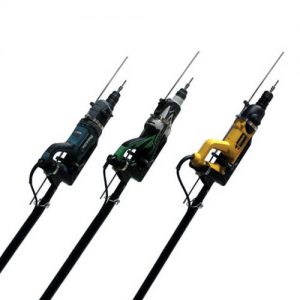 Drilling overhead into concrete can be grueling and exhausting work. It’s not surprising that several companies have come up with special machines and devices to keep the operator on the ground and to make this arduous job a little easier. One of the least expensive and most innovative of these tools is the Overhead Drill Machine (ODM).
All concrete anchors require holes. So if you want to attach a hanger or secure something to a concrete ceiling overhead, drilling into concrete is a fact of life. Traditional methods include climbing a ladder with a hammer drill, setting up scaffolding or renting a scissor lift. Fatigue and muscle strain from repeatedly drilling overhead can lead to injury to the neck, back and shoulders. Safety should always be a major concern when an operator is performing a strenuous and labor intensive job for long periods of time.
Several patents have been filed dating back to 1984 for machines like “overhead drill jig” and “Jig assembly for drilling vertically upward”. There was even a University of California study funded through national labor and safety grants. As a result, there are several machines being marketed. These machines are designed to drill holes from ¼” to ¾” in diameter for commercial building trades (fire sprinklers, HVAC, electrical, plumbing, suspended ceilings and data communications).
The most expensive of these tools comes with a special drill cradle, a mobile base, a winch system to push the drill against the ceiling and a vacuum system to reduce dust. There is one model that drills two holes at once, a set distance apart. These tools are bulky and require preparation and planning to set up. However, they definitely make the job less onerous. These tools retail from around $2,000 to $3,500.
A less expensive alternative places the hammer drill at the end of a telescoping pole, which is then lifted to the ceiling by hand or with a foot pedal. These tools were designed to fasten suspended ceiling wires to concrete ceilings in Canada on jobs where powder actuated tools are restricted. They have proven to be versatile and commercial grade, able to withstand the punishment of high volume jobs.
The most economical of the telescoping poles uses a ceiling probe to switch the hammer drill on and off. As the probe is depressed against the ceiling, it pushes the trigger of the hammer drill, thereby activating the trigger. This mechanism eliminates the need for a remote switch and allows the operator to hold the tool securely with both hands.
Beware of tools that do not place the hammer drill directly against the ceiling. Hammer drills are engineered to impact and rotate a carbide bit at a speed that drills a hole efficiently in hard concrete. When you put a long extension between the hammer drill and the ceiling, you lose efficiency and will eventually destroy the extension tool.