by Docs Industries | Aug 15, 2024
In today’s fast-paced world where technology underpins nearly every aspect of life, effective cable management has emerged as a critical necessity for ensuring the safety, performance, and organization of low voltage systems. Among the various tools used for cable management, J hooks and bridle rings play pivotal roles in supporting and organizing cables, particularly in commercial and industrial settings. At Docs Industries Inc., a leading manufacturer and supplier, we understand the importance of using these tools effectively to enhance cable management solutions. This article delves into the specific mounting options for J hooks and bridle rings, demonstrating how they can be effectively integrated into low voltage installations.
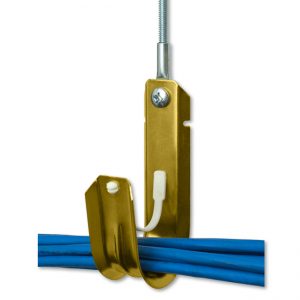 1. Understanding J Hooks and Bridle Rings
What Are J Hooks?
J hooks The Role of J Hooks and Bridle Rings in Low Voltage Cable Management
In an increasingly connected world, the importance of effective cable management cannot be overstated. As businesses and homes become more reliant on low voltage systems for networking, telecommunications, and other applications, reliable cable management solutions are critical. Among the many tools available, J hooks and bridle rings play a vital role in organizing and supporting low voltage cables. This article will explore various mounting options for these accessories, focusing on their application for beams, beam flanges, horizontal and vertical surfaces, ceiling wire, and threaded rods.
Understanding J Hooks and Bridle Rings
Before delving into the mounting options, it’s essential to define what J hooks and bridle rings are.
– J Hooks: These are curved, hook-like supports designed specifically for holding open cables. Their design allows for easy cable placement and removal, making them ideal for environments that require frequent maintenance and upgrades.
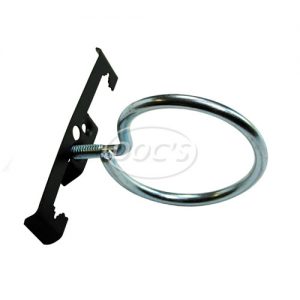
– Bridle Rings: These are circular rings used to support multiple cables at once. They help in maintaining the organization by ensuring that cables are bundled together, reducing the risk of tangling and damage.
Both accessories contribute to a tidy, efficient, and safe cable management system, which ultimately enhances performance and reliability.
1. Mounting Options for J Hooks and Bridle Rings
The versatility of J hooks and bridle rings is reflected in the variety of mounting options available. Proper installation is key to ensuring the longevity and effectiveness of your cable management system. Here are several mounting options worth considering:
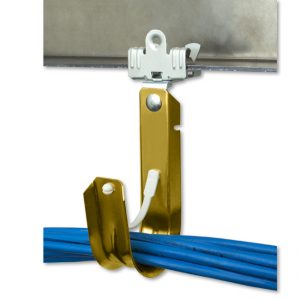 1.1 Beams and Beam Flanges
Mounting J hooks and bridle rings on beams or beam flanges is a common practice in commercial and industrial settings.
– Installation Tips:
– Use appropriate clamps or brackets to secure the hooks or rings.
– Ensure that the weight of the cables is evenly distributed to prevent any sagging or wear over time.
– Consider using a combination of J hooks and bridle rings to accommodate varying cable sizes.
1.2 Horizontal and Vertical Surfaces
For installations on horizontal or vertical surfaces, such as walls or equipment racks:
– Installation Tips:
– Drill into the Surface: Secure the hooks/rings directly to walls using screws. This method provides a solid foundation for supporting the cables.
– Utilize Wall Plates: Employ wall plates that allow for the installation of multiple hooks or rings in one area for maximum organization.
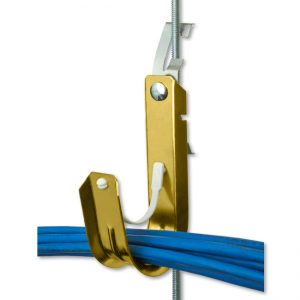 1.3 Ceiling Wire
Ceiling wire can be an excellent mounting medium for J hooks and bridle rings, particularly in open spaces.
– Installation Tips:
– Wire Support Systems: Ensure that the ceiling wire is rated for the weight loads it will carry. Use appropriate fasteners to attach your hooks or rings to the wire.
– Maintenance Accessibility: Leave adequate room around the installation for easy access during maintenance or cable adjustments.
1.4 Threaded Rod
For a more versatile mounting solution, threaded rods offer flexibility for both horizontal and vertical cable runs.
– Installation Tips:
– Create Support Systems: Use multiple rods to create a supporting framework for the hooks and rings, allowing for long spans without sagging.
– Adjustability: The use of nuts and washers on threaded rods enables height adjustments, accommodating various configurations as needed.
 2. Best Practices for Cable Management Using J Hooks and Bridle Rings
In addition to exploring mounting options, adhering to best practices when using J hooks and bridle rings can significantly enhance cable management efficiency:
1. Plan Cable Routes: Before installation, designing a comprehensive route for all cables ensures that your management system is efficient and accessible.
2. Label Cables: Clear labeling helps identify cables, especially in complex systems. This practice will save time during troubleshooting and maintenance.
3. Avoid Overloading: Each J hook or bridle ring has a weight capacity. Overloading them can lead to damage or inadequate support, so be sure to understand the limits.
J hooks and bridle rings are indispensable components of effective low voltage cable management systems. Their variety of mounting options, including beams, horizontal and vertical surfaces, ceiling wire, and threaded rods, allows for flexibility in installation while promoting organization and safety. By adhering to best practices and understanding the capabilities of these tools, businesses and homeowners alike can ensure a clean, efficient, and reliable network infrastructure. As the industry continues to evolve, investing in quality cable management solutions will remain critical to supporting modern technological demands.
by Docs Industries | Sep 2, 2022
If you have ever been involved in installing network cable then you will know that the most important thing to keep in mind is safety and that the easiest way to ensure safety is by being organised. Gone are the days of haphazard use of cable ties or unnecessary bends or rolls in the wire. Use of specifically designed products like J hooks or bridle rings will ensure a well laid out and safe network cable setup.
Network cable installation can be stressful enough but it is important to keep an eye on the future with regards to maintenance and dealing with possible malfunctions or other issues. There is no point in installing network cable in a rush so that the whole system is taken down because you can’t remove one without others.
Cables should never be run in unsafe locations or touching off of pipes or tiles. They should not be bundled too tightly and kinks or bends in the cable should be avoided. They should also be clearly labelled for ease of maintenance.
J hooks are a simple and cost effective solution to cable management. A metal hook in the shape of a J, they are cheap to buy and easy to install on walls. They are able to support small bundles of cables, preventing undue stress on the network cable. The base of the J is also broad enough to prevent kinks or bends in the cable.
Another method of cable management is the use of bridle rings. These are metal rings with a screw that can be installed in predrilled holes in a hole or ceiling. They are an effective method of cable management and support as they are non obtrusive, easy to install, and easy to remove if there is an issue.
Our selection of J hooks and bridle rings should cover all your needs but if you have a specific product need or further queries with regards to their installation or use then do not hesitate to get in contact with our team for further details.

by Docs Industries | Mar 8, 2019
Question: Are your HOCL-45 and HOCL-90/45H angle clips DSA compliant?
Answer: YES.
Please see the HOCL-45 & HOCL-9045H Submittal Sheet.
The submittal sheet includes both cut sheets showing overall dimensions and a representative image of the clips. As well as excerpts from California DSA IR 25-2.13 REV. 11-09-17, specifically pages 34 & 37.
Part #: HOCL-45
If you look at the second figure on “Sheet No. 4.10” titled “Bracing Wire”, it shows the 45-degree angle clip requirements for bracing wire.
½” TYP from edge to center of the hole where the ceiling wire is tied (HOCL-45 meets this spec).
½” MAX. U.O.N. from edge to center of the hole for the 3/8″ expansion anchor (HOCL-45 meets this spec).
Here are images of the measurements mentioned above as well as a mic. on the 12 gauge thickness:
Part #: HOCL-90/45H
If you look at the first figure on Sheet No. 4.21 titled “Option 1″, it shows a 12 GA X 1″ wide angle clip with a hole for a 3/8″ dia. expansion anchor (HOCL-90/45H meets this spec). It also shows ½” MAX. from edge to center of the hole for a 3/8″ expansion anchor (HOCL-90/45H meets this spec).
You may ask, is DSA compliance acceptable if there is no ICC-ES report?
The specifications called out in DSA IR-25-2.13 are met or exceeded by our clips as is evident in the measurement images posted above.
According to DSA IR A-5 “Acceptance of Product Materials, and Evaluation Reports”, Section 1.1 states “Products, including alternate materials, must have a valid evaluation listing/report issued by a recognized evaluation agency.”
Section 3. VALID LISTINGS…
Section 3.1 “The product or material must comply with CBC. Evaluation reports may not be acceptable if the product does not comply with applicable DSA amendments contained in CBC and/or applicable DSA IRs, or Bulletins.”
Section 3.3 Goes on to list the acceptable evaluation reports in order (ICC ES, IAPMO ES, OSHPD, COLA, NOA). If none of those are available for the product, the last bullet states:
* Other product certification bodies that are certified to be in compliance with ISO/IEC 17065:2012, “Requirements for Bodies Certifying Products, Processing and Services” (for projects submitted under the 2016 and 2013 CBC) and ISO Guide 65, “General Requirements for Bodies Operating Product Certification Systems” (for projects submitted under the 2010 and 2007 CBC).
In essence, in the absence of a third party evaluate report, as long as a product complies with the requirements of CBC, DSA IRS and bulletins, and can be traced with a marking, any certification body that is in compliance with the standards mentioned above may certify compliance.
Furthermore, To the best of our knowledge, no manufacturer has a current ICC-ES report on similar angle clips.
Hilti’s X-CC 45 is not included in their ICC report located here: https://www.icc-es.org/wp-content/uploads/report-directory/ESR-2184.pdf. This report is for powder-actuated ceiling clip assemblies only.
The report listed on their product page for the X-CC 45 is only for:
“Ceiling fastening system Applicable base material Fastener types Recommended installation tools Wire type Section X-CX C Concrete, lightweight concrete over metal deck X-C27 DX 351-CT with Pole Tool Pre-tied to ceiling clip or provided by others 3.3.2 X-CX ALH Concrete, lightweight concrete over metal deck, steel X-ALH 22, X-ALH 27, X-ALH 32 DX 351-CT with Pole Tool Pre-tied to ceiling clip or provided by others 3.3.2 Eye-lag screw Wood, sheet steel EL WS, EL S, EL SD Telescopic Screw Ceiling Tool Provided by others 3.3.3”
Tomarco, Powers/DeWALT do not have an ICC-ES report on similar angle clips either.
by Docs Industries | Mar 1, 2019
We’re excited to announce a new feature on our Doc’s Industries website. On every product page, just below the blue “Where to buy” button, there is now an orange “Submittal Request” button. This button allows you to quickly and easily request a submittal sheet on the product you are viewing. We hope that this new option will help you and your customers navigate the submittal process with minimal effort.